
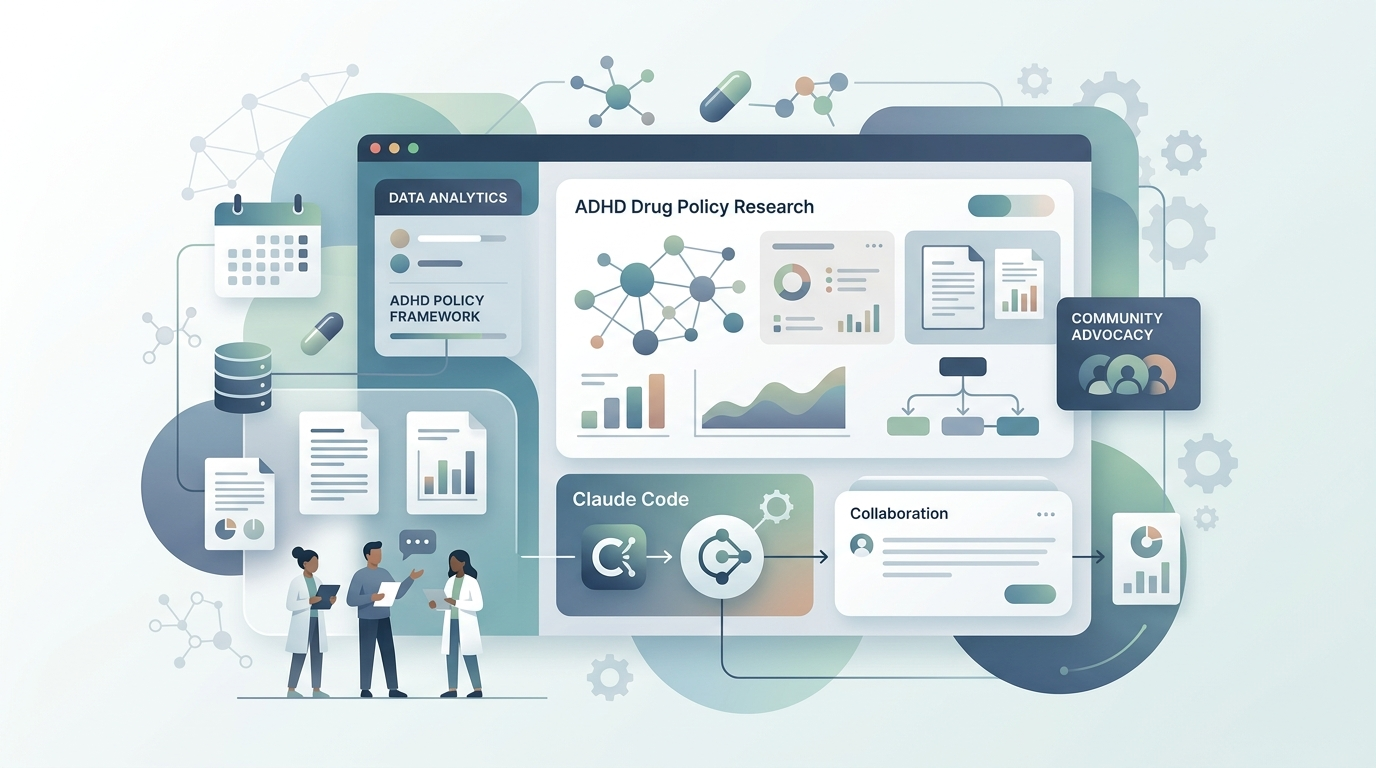
An open source ADHD drug policy research workspace built on Claude Code
A real-world example of using a Claude Code research workspace template for ADHD drug policy research and advocacy.
I recently shared the Claude Think Tank template for policy research, but I wanted to also open source a real, living example of one of these workspaces in action. The Claude ADHD Research Workspace is a public repository where I'm conducting ongoing research into ADHD drug policy.
danielrosehill/Claude-ADHD-Research-Workspace View on GitHubWhy make it public?
Two reasons. First, I love research and I love using Claude Code for research. I genuinely believe that agentic CLIs are ideal companions for deep research work, and that the repository structure, while code-centric by design, is actually far more versatile than most people realize. I've shared templates before, but I figured it was worth open sourcing a real living project alongside the blueprints.
Second, this is really something I care about. ADHD drug policy affects a lot of people, and the research landscape is complex. If it weren't for wanting to demonstrate the workspace pattern, this might have stayed a private repo. So it serves a dual purpose: it's both an exhibit of the methodology and an active workspace.
The folder structure as miniature RAG
The structure follows the same pattern I use across all my research workspaces. The context/ folder acts as what I think of as miniature RAG: contextual data chunked as logically and cleanly as possible. I sometimes use actual RAG systems, but rarely. What I do consistently is try to implement the best practices of RAG in a simple folder hierarchy.
The prompts/ directory subdivides into drafting, to-run, and run, which maps onto workflows for batch execution. And outputs/ is where all the research results land, following a "gather and distill" approach: pipe all runs into a folder, prune cautiously, organize carefully, and eventually concatenate them into meaty outputs. I tend strongly toward targeting PDF as my end delivery format.
Policy-specific layers
On top of the foundational research structure, this workspace adds some domain-specific components. There's a lobby workflow mapped in the CLAUDE.md that delineates between initial research (first drafts) and later, more authoritative articulations of idealized policy. There's also a data pipeline that goes from document data in policy reports to extracted structured data, which mirrors some of my professional work.
The nice thing about sharing this publicly is that you can see the methodology in context. Templates are great for getting started, but seeing how a workspace evolves with real research over time tells you a lot more about whether the approach actually works. And I can confirm: it does.
If you're interested in the research or the methodology, check out the repo on GitHub. The context folder has the full background on why this particular topic matters to me.
danielrosehill/Claude-ADHD-Research-Workspace View on GitHub