
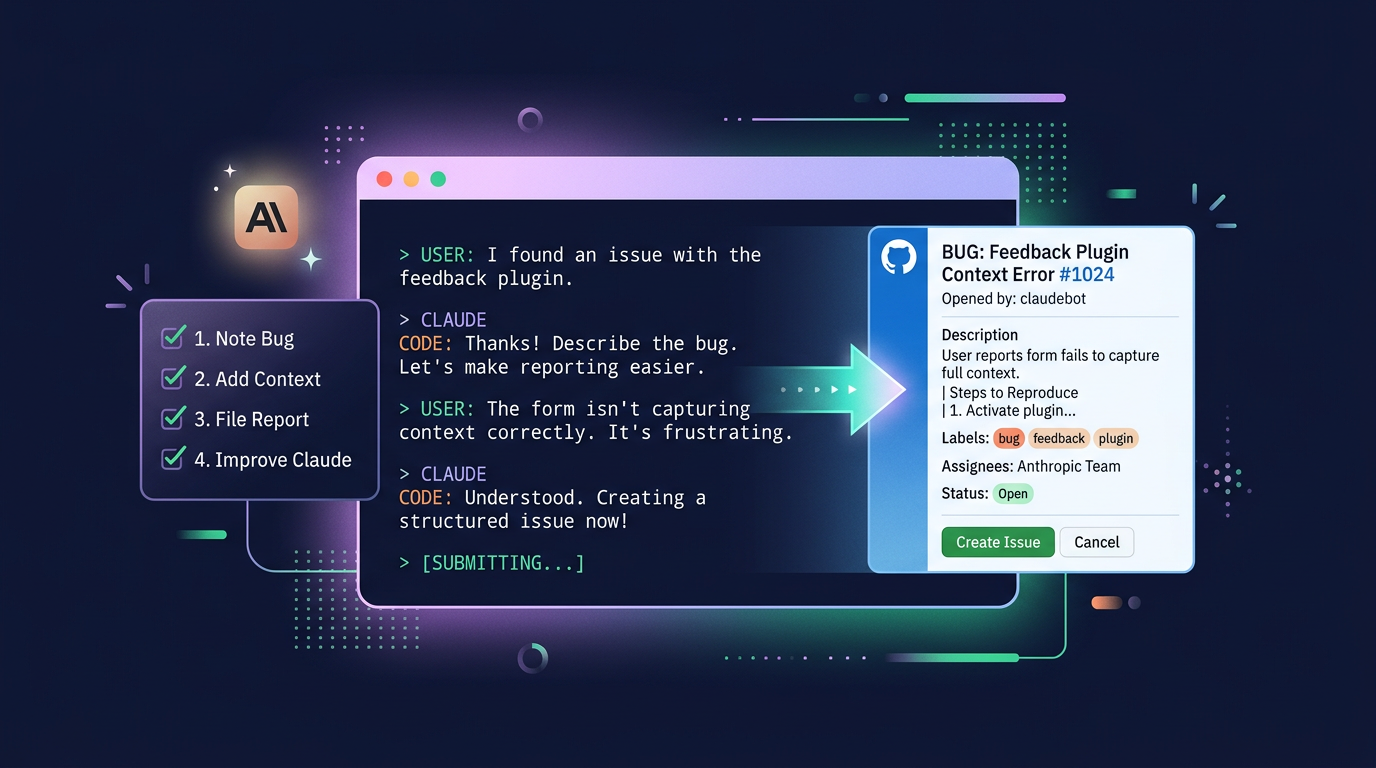
Latest addition to my Claude Code plugin marketplace: a small plugin that puts Claude itself to work on the job of reporting bugs and feature requests back to Anthropic.
Repo: danielrosehill/Claude-Code-Feedback-Plugin.
The idea
Claude Code is improving quickly, which means it's also accumulating rough edges quickly. The standard way to report those — the GitHub issue forms on anthropics/claude-code — are perfectly good, but there's friction. You have to remember which template to use, fill the fields out in the format the form expects, summarise what you were doing, describe your environment, attach the right context. In practice, most of the bugs and feature ideas I notice in a session never get filed. I'm busy; the friction wins.
This plugin closes that gap. It's an agent skill bundle that installs into Claude Code so that when something goes wrong (or when you notice something missing), you can just tell Claude about it in the session you're already in, and Claude will interview you against the current issue template, draft the body in the exact format Anthropic's forms expect, and file it via gh.
The point is to lower the activation energy for good feedback to roughly zero, so that more of the signal that users are noticing in the wild actually makes it into Anthropic's tracker — and thereby into the product.
What's in it
Four skills, one per issue type Anthropic currently accepts:
bug — triggers on "report a bug", "file a bug", or when you describe broken CLI / tool / harness behavior.
feature-request — triggers on "request a feature", "I wish Claude Code could…", "suggest".
model-behavior — for bad model output, refusals, hallucinations, low-quality responses. A distinct category from bugs, because the fix lives in the model, not the CLI.
docs — wrong, missing, or outdated Claude Code documentation.
Plus a fifth utility skill, refresh-templates, which keeps the cached forms in sync and flags when Anthropic adds a new issue type the plugin doesn't yet cover.
Self-healing templates
The interesting piece is the self-healing bit. Anthropic's issue forms are not static: required fields get added, dropdown options change, new issue types appear. A plugin that hardcodes the field list goes stale within weeks.
So this one doesn't hardcode anything. On every invocation it fetches the live issue-form YAML from raw.githubusercontent.com/anthropics/claude-code/main/.github/ISSUE_TEMPLATE/, parses the current fields, and interviews you against whatever is there now. A cached copy is kept as offline fallback. If the live copy differs from the cache after a successful run, you're prompted to refresh. And if refresh-templates detects a new issue-form file upstream that has no corresponding skill in the plugin, it offers to scaffold one.
In other words: Anthropic can keep iterating their feedback intake and the plugin keeps working. The only thing that would break it is Anthropic moving off GitHub issue forms entirely, at which point the plugin would need a different fetcher — but the interview-render-file pattern would carry over.
Install
From my marketplace (add it first with /plugin marketplace add danielrosehill/Claude-Code-Plugins if you haven't):
/plugin install claude-code-feedback@danielrosehill
Or install straight from the repo:
/plugin install danielrosehill/Claude-Code-Feedback-Plugin
Requirements are minimal: gh CLI authenticated (gh auth status should be clean), curl, and network access for live-template fetching. The cached fallback keeps it usable offline.
Why publish this
Partly selfish: I file more feedback when the friction is low, and I get a better Claude Code as a result. But there's a broader point. A lot of the intelligence about what's actually wrong with a tool sits inside the sessions where people are using it — not in the moment they later sit down to write an issue. Putting the agent itself in charge of turning that lived experience into a well-formed report means more of the signal survives the trip to Anthropic's tracker, and it means the reports that do arrive are structured the way the triagers want them. Both sides win.
If you use Claude Code regularly, install it, and file the thing you were going to shrug off next time. MIT-licensed, contributions welcome, and the self-healing scaffolder should make it easy to bolt on any new issue type Anthropic adds down the line.
Repositories
Daniel Rosehill's Claude Code plugin marketplace
Claude Code is an agentic coding tool that lives in your terminal, understands your codebase, and helps you code faster by executing routine tasks, explaining complex code, and handling git workflows - all through natural language commands.