
Red Alert SOPs: Printable Preparedness Checklists for Life in Israel
A set of 15 printable standard operating procedures for red alert readiness in Israel, covering daytime and nighttime postures, siren responses, and emergency supplies.
The Project
https://github.com/danielrosehill/Israel-Preparedness-SOPs
danielrosehill/Israel-Preparedness-SOPs View on GitHubThis repository contains 15 Standard Operating Procedures for red alert readiness in Israel, written specifically for people living in buildings without a Mamad (residential protected room) or Mamak (floor protected room). If your building has a Mamad, your primary action during a siren is simply to enter it. These SOPs address the more complex and stressful situation of needing to reach an external shelter or choose an alternative protected space under extreme time pressure. They are written in Typst and compiled to printable PDFs.
Important: this is NOT an official government resource. The SOPs are based on Home Front Command (Pikud HaOref) guidelines but are not endorsed or verified by any official body.
Readiness Postures
Six SOPs cover readiness checklists for different situations:
Daytime Readiness Posture (SOP-1) -- What to have on your person at all times: phone with Red Alert app and volume on, closed-toe shoes suitable for running (not sandals), keys accessible, go bag by the front door, hallway clear of obstructions. Know your nearest 3 shelters, the time-to-shelter for your locality, and the protected space priority order (shelter > inner stairwell > inner room).
Nighttime Readiness Posture (SOP-2) -- Before-bed preparation so you can wake, dress, and reach shelter in under 90 seconds. Clothes laid out by bed, closed-toe shoes within reach, torch on the nightstand, no earplugs, phone charging with Do Not Disturb disabled or alerts whitelisted. Route to nearest shelter walkable in the dark.
Escalation Readiness (SOP-3) -- 72-hour preparation checklist for when the security situation deteriorates.
Shelter Check (SOP-4) -- How to find, verify, and time your route to your nearest shelters.
Mobility-Limited Readiness (SOP-5) -- Adapted posture for elderly or mobility-limited individuals.
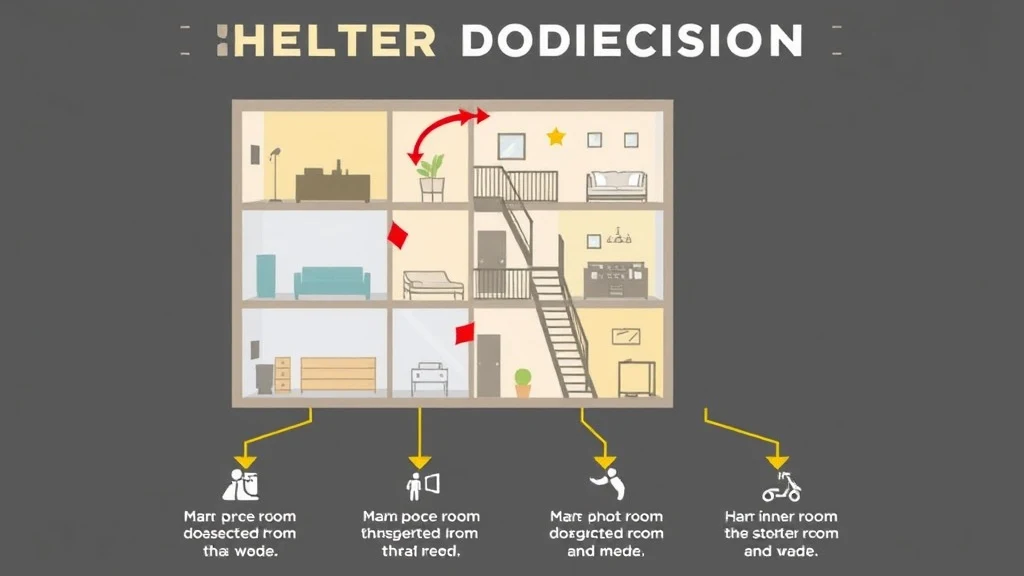
Choosing a Protected Space (SOP-8) -- Priority decision flowchart for selecting shelter when you have no Mamad.
Siren Response Cards
Two SOPs provide immediate-action reference cards for when a siren sounds:
Siren Response Quick Reference (SOP-6) -- Covers 10 scenarios: at home without Mamad (decide if shelter is reachable; if not, go to inner stairwell staying where 2+ floors are above you; if no stairwell, innermost room with maximum walls and minimum windows), driving (pull over, exit, lie face-down away from vehicle), on a bus, outside, in a public building, in an elevator, in a prefab structure, with children, and mobility-limited. Key rules: never use kitchen or bathroom as shelter, never shelter in the building entrance lobby, wait 10 minutes after the last siren.
Siren Response with Infant (SOP-7) -- 7 scenarios for parents with a baby (0-18 months) including infant go-bag additions (pacifier, formula, nappies, muslin). Uses a structured carrier for hands-free evacuation rather than a stroller.
Preparedness SOPs
Seven SOPs cover longer-term preparedness based on Home Front Command guidelines:
Emergency Supplies Kit (SOP-9) -- 72-hour stationary supply kit: water, food, power, medical supplies, with storage and maintenance schedules.
Family Emergency Plan (SOP-10) -- Family coordination, assigned roles, drill schedules, meeting places, and communication plans.
Home Preparation (SOP-11) -- Securing your home: Mamad inspection, furniture anchoring, hazmat awareness, escape routes.
Emergency Contacts (SOP-12) -- Essential phone numbers, alert channels, and information discipline.
Go-Bag (SOP-13) -- Portable emergency grab bag packing list, positioning by the front door, and maintenance schedule.
Accessibility Equipment (SOP-14) -- Equipment for visual, hearing, and mobility impairments plus communication aids.
Pet Emergency Preparedness (SOP-15) -- Pet go-bag, evacuation procedures, shelter policies, and service dog requirements.
All SOPs are available as individual PDFs and as combined collections (readiness postures, siren responses, preparedness, and a complete 23-page master document). The source data is stored as YAML files in the data/ directory, compiled to PDF via Typst templates. A static HTML site with download links is also generated and hosted via GitHub Pages. The repository was co-authored with Claude Opus and is freely shareable with attribution.