
MCP Aggregation, Gateway, and Proxy Tools: State of the Ecosystem (Q1 2026)
A survey of 17 MCP aggregation, gateway, and proxy tools — evaluating how they handle hierarchy, federation, deployment flexibility, and per-client tool visibility.
This document evaluates the current landscape of MCP (Model Context Protocol) aggregation, gateway, and proxy tools as of early 2026. Each tool is assessed against a target architecture requiring a three-level hierarchy, 1:many endpoint-to-namespace mapping, nested federation, deployment flexibility, multi-transport support, tool-level controls, per-endpoint auth, and client-dimension visibility.
MetaMCP's Three-Level Hierarchy
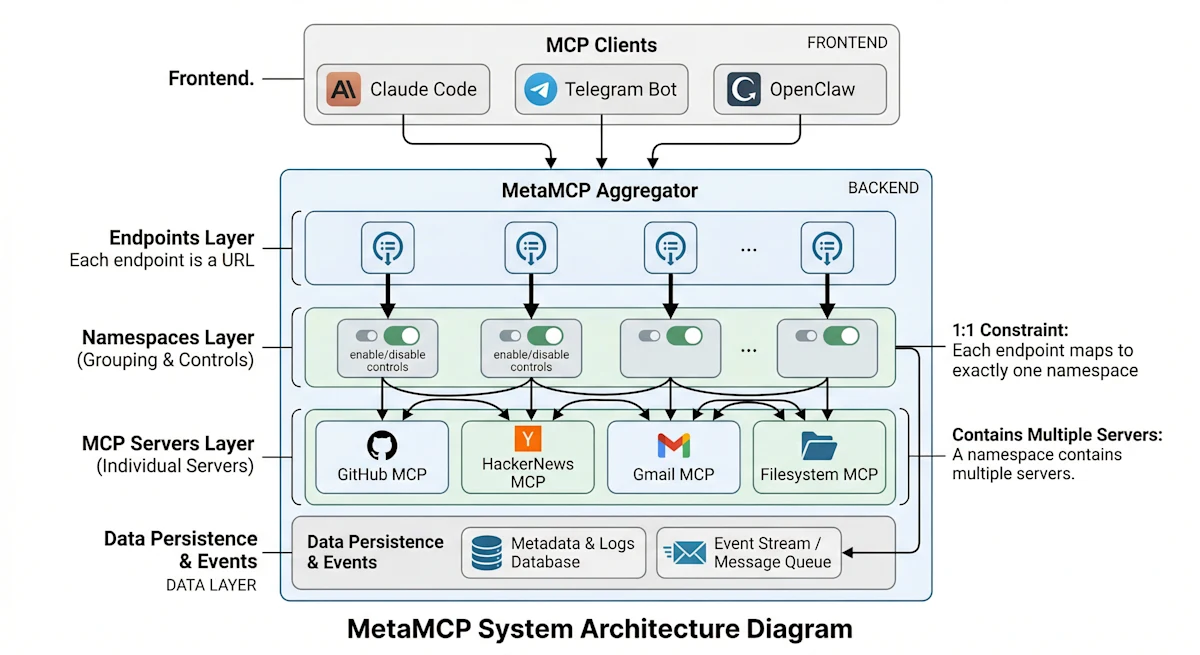
MetaMCP uses a three-level hierarchy for aggregating MCP servers: Servers → Namespaces → Endpoints.
Servers are the base unit — each is an individual MCP server configuration. Namespaces group one or more servers together and serve as the organizational layer where you enable/disable individual servers or specific tools, apply middleware, and override tool names and descriptions. Endpoints are the public-facing URLs that clients connect to. Each endpoint is assigned exactly one namespace and exposes that namespace's tools via SSE, Streamable HTTP, or OpenAPI transports.
Design Friction: The 1:1 Endpoint-to-Namespace Constraint
The current MetaMCP design enforces a strict 1:1 mapping between endpoints and namespaces. This creates friction when you need to organize servers along multiple dimensions simultaneously.
In practice, there are at least two natural organizing dimensions for MCP servers:
Context — Who is this for? (e.g., Personal vs Work)
Tool Cluster — What kind of tools are these? (e.g., Dev, Creative, Comms, Analytics)
An endpoint should represent a context (Personal, Work), and multiple namespaces representing tool clusters should be assignable under it. This would allow you to maintain logical grouping of tool clusters while exposing them all under a single context-based endpoint.
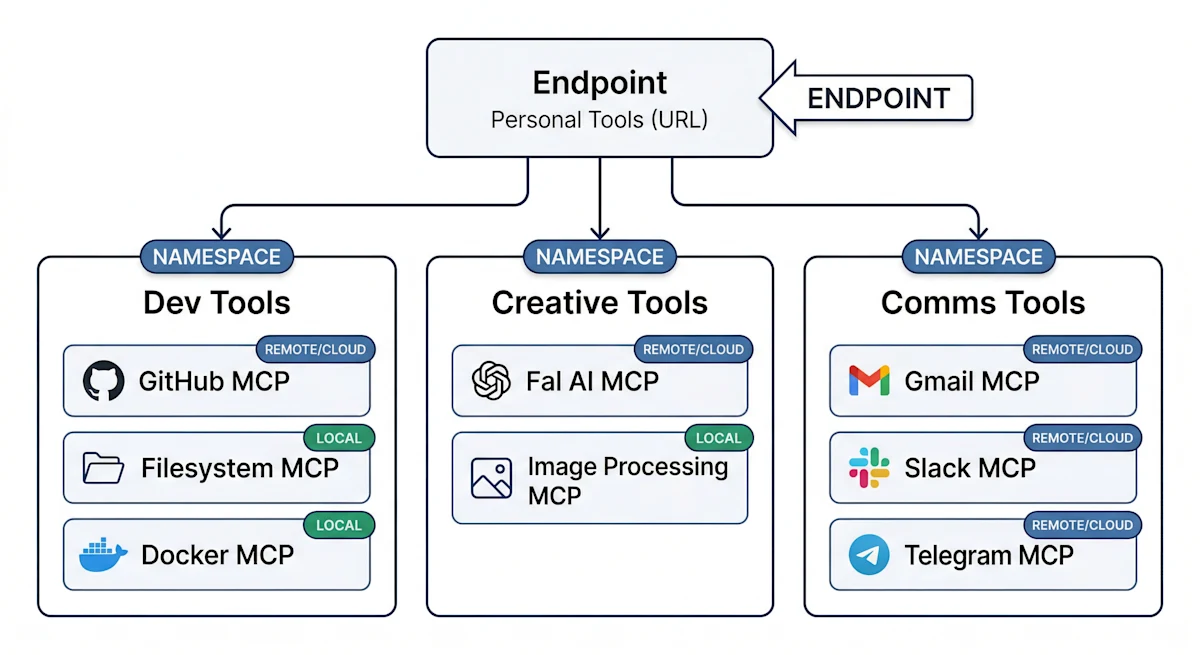
Because of the 1:1 constraint, you must choose one of two compromises: either one mega-namespace per context (losing tool cluster organization — everything is flat) or one endpoint per cluster (losing the context grouping — the accessing tool must be configured with multiple endpoints). Neither preserves both dimensions.
Deployment Topology
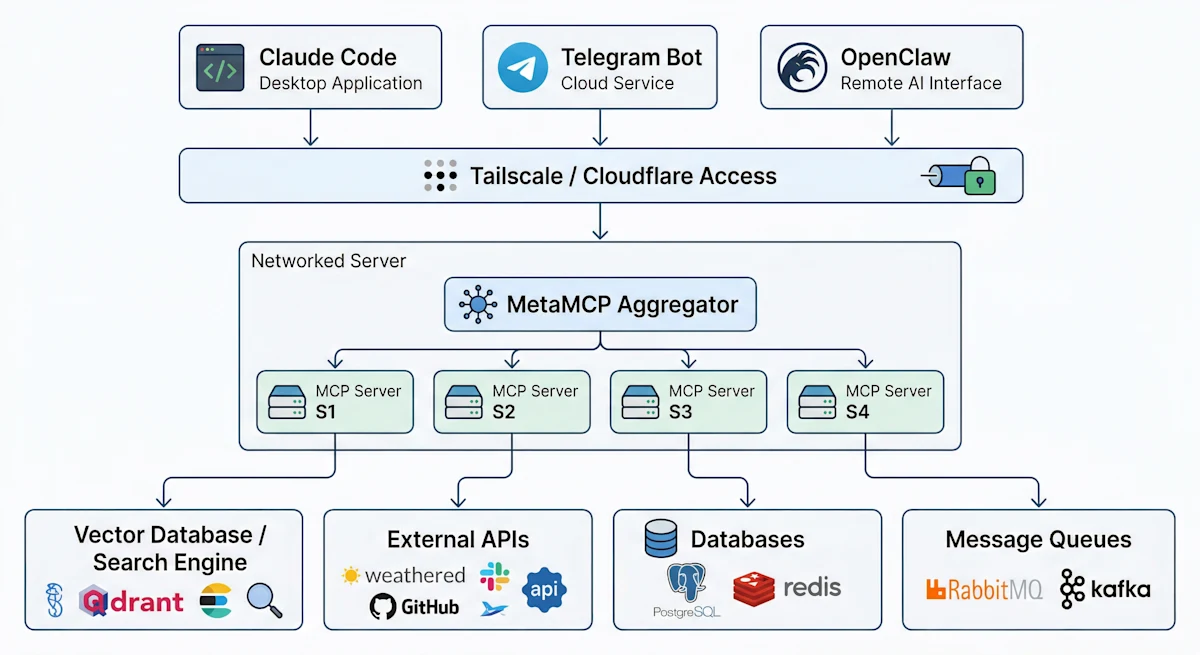
In practice, the current deployment uses two MetaMCP instances: one on localhost (desktop/workstation) for MCP servers that need local file access, and one on an Ubuntu VM (local server) for everything else. This split exists not by design choice but by necessity — some MCP servers don't have a clean way to pass in binary files or local resources over the network.
The preferred architecture would consolidate all MCP servers onto a single networked resource, accessible from any client via Tailscale or Cloudflare Access:
Multi-Level Aggregation (Nested Bundling)
Aggregation tools like MetaMCP typically assume a single flat level of bundling. In practice, a more useful pattern is nested aggregation — aggregators that themselves consume other aggregators, creating a tree of MCP access. Local device clusters (e.g., Raspberry Pis, SBCs) get their own grouped MCP server first, and that grouped server then connects into the main MetaMCP aggregator on the local VM.
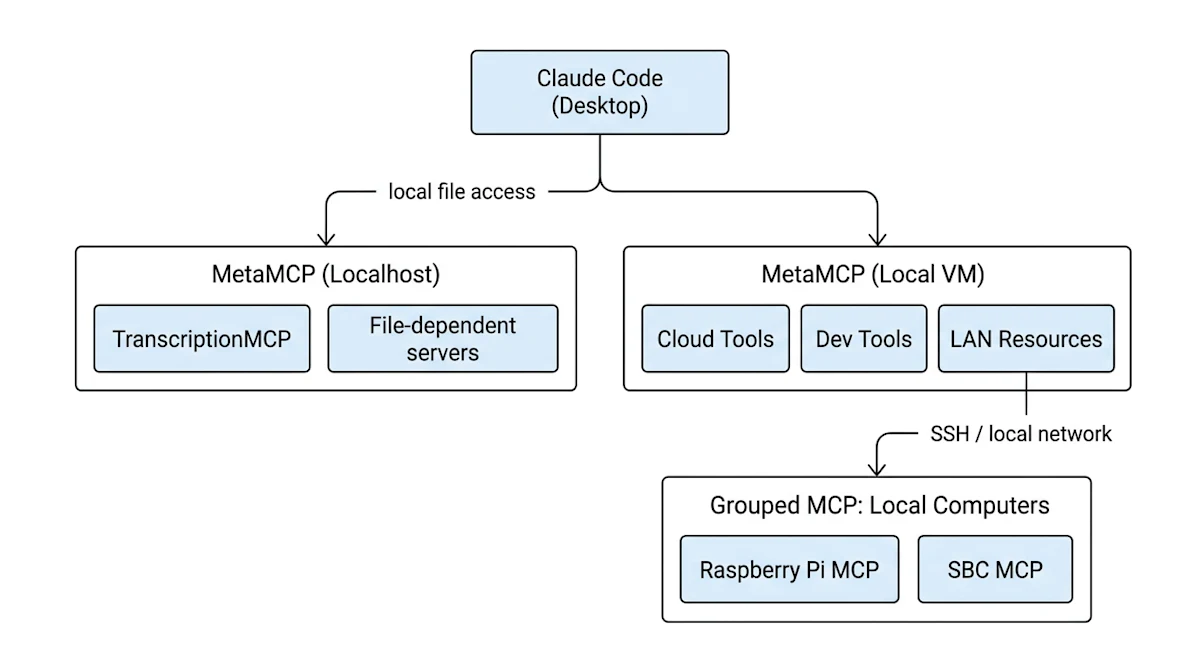
This is effectively a federation pattern applied to MCP — not just flat bundling, but hierarchical routing of tool access across network boundaries. Each level of aggregation is independently manageable, and the client doesn't need to know about the multi-hop path.
Ecosystem Survey: 17 Tools Evaluated
I surveyed the full MCP aggregator/gateway landscape as of Q1 2026, evaluating 17 tools: agentgateway (Linux Foundation), Bifrost (Maxim AI), Cloudflare MCP Server Portals, IBM ContextForge, Kong, MCP-Gateway (aiguicai), MCP Mesh (deco.cx), mcp-proxy (tbxark), MCPJungle, MCProxy (igrigorik), MCPX (Lunar.dev), MetaMCP, Microsoft MCP Gateway, Obot, Portkey AI Gateway, Supergateway, and Unla (AmoyLab).
Each was assessed against the target architecture's requirements: three-level hierarchy, 1:many endpoint-to-namespace mapping, nested/federated aggregation, self-hosted deployment, multi-transport support, tool-level controls, per-endpoint auth, and client-dimension visibility.
Key Findings
No tool fully satisfies all target requirements. The ecosystem has converged on flat aggregation with RBAC — good for enterprise governance, but not the multi-dimensional organization model described here.
Tier 1 — Closest overall:
IBM ContextForge — Virtual servers approximate namespaces, mDNS federation for nested aggregation, broadest transport support (7+ protocols). Gap: 1:many endpoint-to-virtual-server mapping unverified.
MetaMCP — Only tool with explicit Servers/Namespaces/Endpoints hierarchy and tool description overrides. Gap: 1:1 endpoint-to-namespace constraint, no federation.
Tier 2 — Strong in specific dimensions:
MCPJungle — Tool Groups with include/exclude, per-client allowlisting. Still 1:1, no federation.
Bifrost — Virtual keys for client-dimension visibility, innovative Code Mode for token optimization. No hierarchy, no federation.
MCP Mesh — Virtual MCPs with multi-level RBAC and smart tool selection. No federation, sparse docs.
agentgateway — Linux Foundation-backed with strong governance, multi-tenancy, and v1.0 maturity. No namespace hierarchy.
Tier 3 — Useful as components: Supergateway (transport bridge for STDIO-to-SSE/HTTP), Unla (REST-to-MCP conversion), Kong (enterprise API gateway with MCP plugin), and mcp-proxy (lightweight aggregation with tool filtering).
The Ecosystem Gap
No tool provides all of: (a) a clean three-level hierarchy with 1:many endpoint-to-namespace, (b) first-class nested/federated aggregation, (c) per-client tool visibility as a distinct dimension, and (d) lightweight self-hosted deployment. This remains an open design space as of Q1 2026.
Recommended Investigation Path
ContextForge — verify whether virtual servers can be composed under a single endpoint and whether federation supports true nested aggregation.
MetaMCP — monitor for 1:many endpoint-to-namespace support; the maintainers are aware of this design limitation.
MCPJungle — evaluate Tool Groups as a practical alternative to MetaMCP namespaces.
Hybrid approach — MetaMCP for namespace/endpoint management + manual federation by registering one MetaMCP endpoint as a server in another instance.
Research conducted April 2026. Tool capabilities based on documentation and public sources; features may have changed since publication. The full detailed research with per-tool fits/gaps analysis is available on GitHub.
Ideating/brainstorming some frustrations with MCP aggregation, with Claude, and planning an easier approach